Product Details
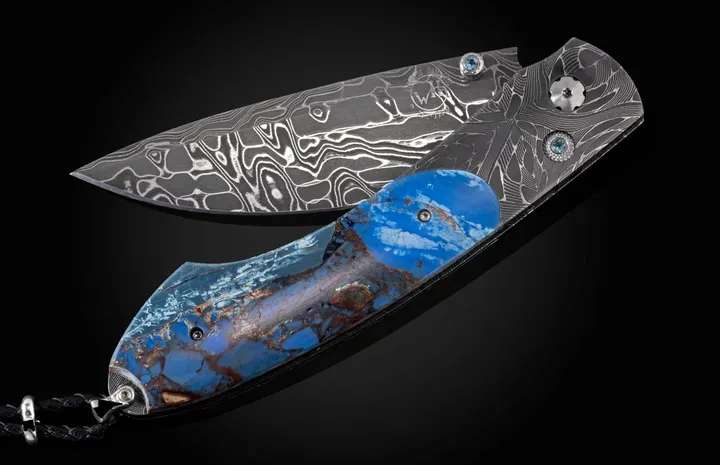
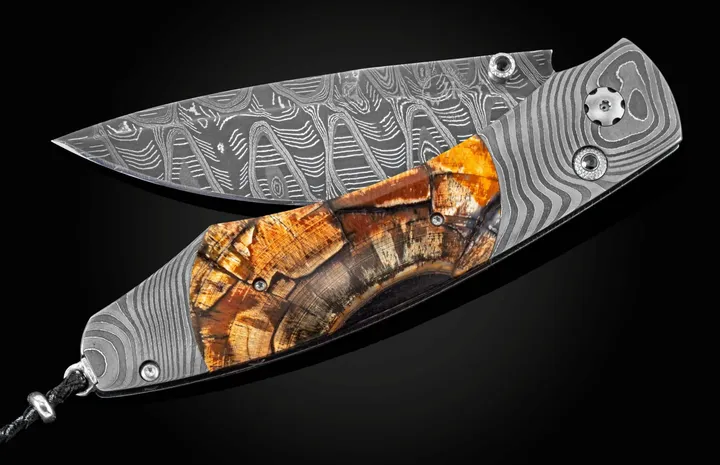
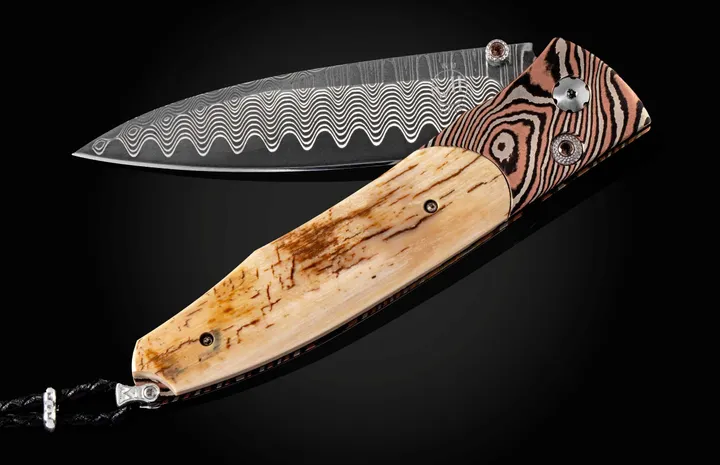
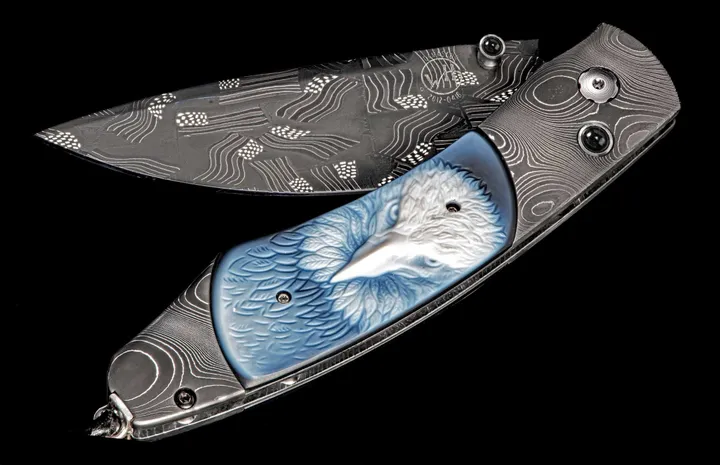
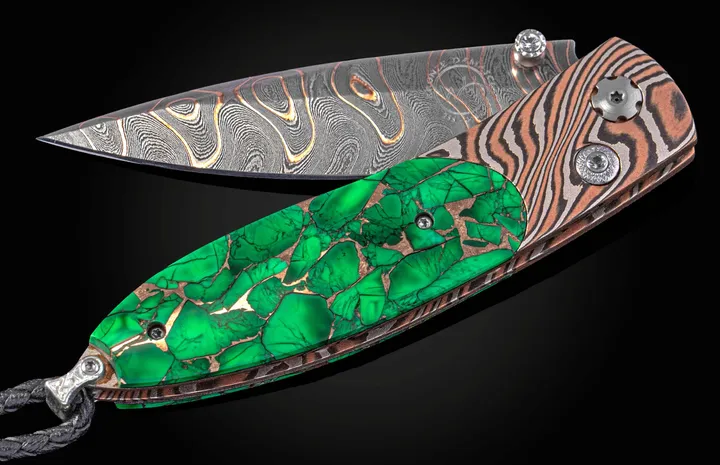
The Spearpoint 'Blue Fusion' features a beautiful frame in hand forged 'X-Out' damascus by Chad Nichols. The handle is inlaid with a mesmerizing scale of 'Mammoth Fusion'. The blade is hand-forged 'Intrepid' damascus by Chad Nichols; the one-hand button lock and the thumb stud are set with blue topaz gemstones. A remarkable design that gives you an instrument with a full-size secure grip, and a versatile deep-belly blade, the Spearpoint epitomizes William Henry’s core philosophy – that superlative function deserves to be elevated to superlative art. The ‘Blue Fusion’ features some of the most exotic materials, superlative artistry, and hand-forged metals that are the hallmark of William Henry's collections; a timeless heirloom to be proudly worn and used for a lifetime before being handed-down to another generation.
Style B12 BLUE FUSION
Materials
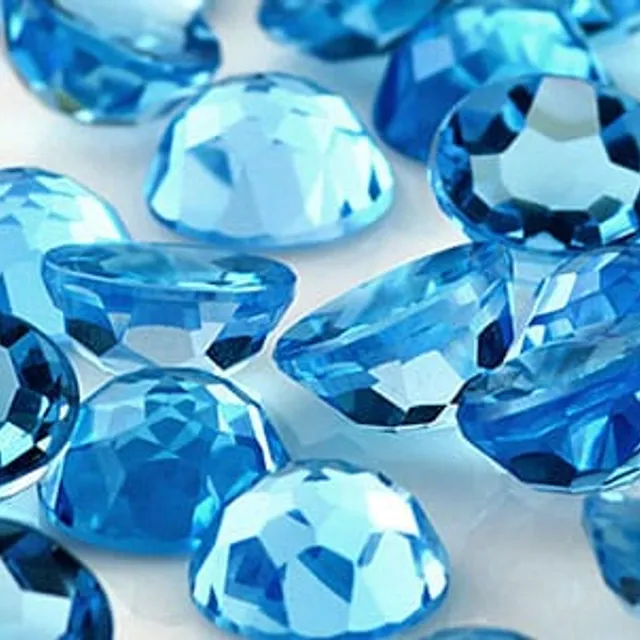
Blue Topaz
Topaz is a rare, extremely hard gemstone with an exceptionally wide color range that, besides brown, includes various tones and saturations of blue, green, yellow, orange, red, pink, and purple. The ancient Greeks believed that topaz gave them strength. In Europe during the Renaissance (the period from the 1300s to the 1600s) people thought that topaz could break magic spells and dispel anger. For centuries, many people in India have believed that topaz worn above the heart assures long life, beauty, and intelligence. Today, topaz is one of the US birthstones for November, while blue topaz is a birthstone for December
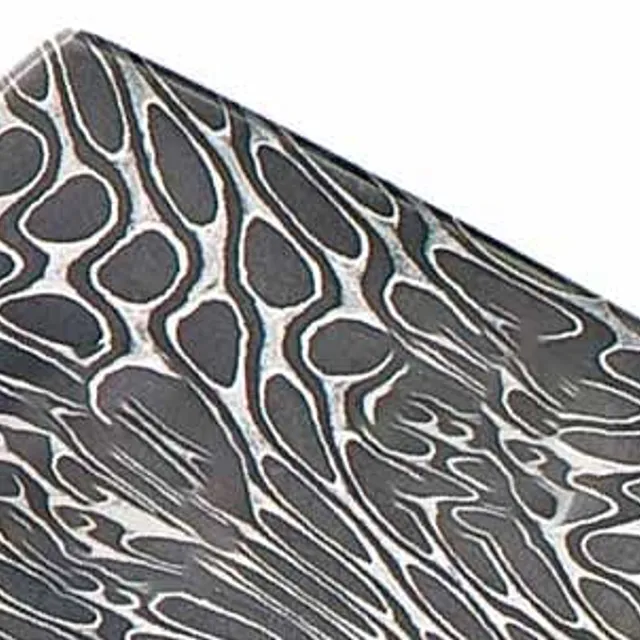
Etched damascus
This material obtained by immersing a traditional damascus billet it in an acid solution. The process creates a striking visual contrast by enhancing the components that are more susceptible to the etching of the acid.
Fossil Mammoth Tusk
Literally the ring section of the fossil tusk of a Woolly Mammoth that walked the Earth at least 10,000 years ago. Modern humans coexisted with woolly mammoths during the Upper Paleolithic period when they entered Europe from Africa between 30,000 and 40,000 years ago. Prior to this, Neanderthals had coexisted with mammoths during the Middle Paleolithic and up to that time. Woolly mammoths were very important to Ice Age humans, and their survival may have depended on these animals in some areas. The woolly mammoth is the next most depicted animal in Ice Age art after horses and bisons, and these images were produced between 35 and 11.500 years ago. Today, more than five hundred depictions of woolly mammoths are known, in media ranging from carvings and cave paintings located in 46 caves in Russia, France and Spain, to sculptures and engravings made from different materials. William Henry's fossil Mammoth tusk is harvested in Alaska and Siberia, often from underwater. It is a rare and mesmerizing material, a living testimony of the dawn of Mankind.
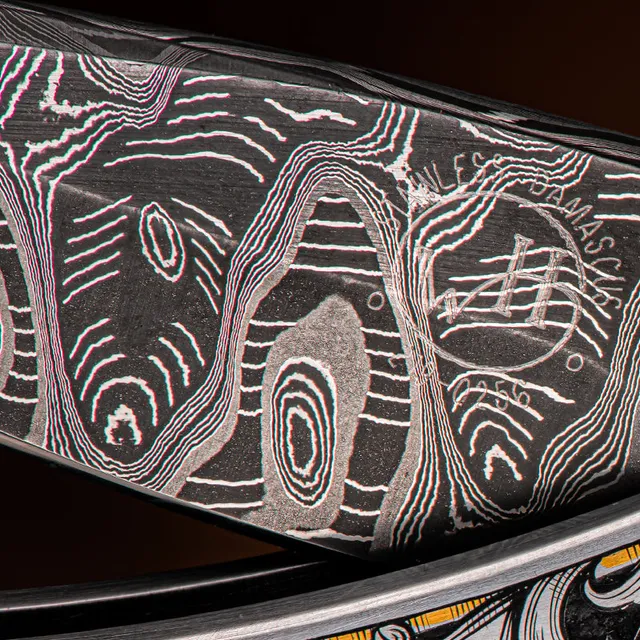
Hand-forged damascus
Damascus steel was a term used by several Western cultures from the Medieval period onward to describe a type of steel created in India and used in sword making from about 300 BC to 1700 AD. These swords were characterized by distinctive patterns of banding and mottling reminiscent of flowing water. Such blades were reputed to be not only tough and resistant to shattering, but capable of being honed to a sharp and resilient edge. William Henry's damascus is made from several types of steel welded together to form a billet. The patterns vary depending on how the damascus artist works the billet. The billet is drawn out and folded until the desired number of layers are formed. William Henry damascus billets are forged with a minimum of 300 layers. William Henry works with a handful of the very best damascus artists/forgers in the U.S.
Features & Specs
Features
- One-hand button lock system
- Leather carrying case
- Shipped in an elegant wood presentation box
Dimensions
- Blade3.06" (77.7mm)
- Handle4.13" (104.9mm)
- Overall open7.19" (182.6mm)